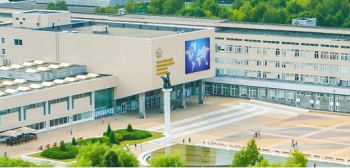
Founded in 1969 as part of the National University of Mongolia, the Mongolian University of Science and Technology consists of five faculties and 13 departments. Approximately 25,000 students (20,000 undergraduates and 5,000 postgraduates) are spread across the several campuses which make up the university. These campuses are located in Ulaanbaatar City, Darkhan, Erdenet, Uvurkhangai, and Sukhbaatar provinces.
The university’s primary location is Ulaanbaatar City, the capital of Mongolia. Home to almost half of the country’s population, the city enjoys rail connections to both Russia and China through the Trans-Siberian Railway and the Chinese rail system respectively. It also has close ties to other nearby global cities such as Seoul in South Korea and Hong Kong.
Teaching at the university covers the following subject areas: Civil Engineering and Architecture, Computer Science and Management, Geology and Petroleum Engineering, Food Engineering and Biotechnology, Information and Communication Technology, Languages, Mathematics, Materials Science, Mechanical Engineering, Mining Engineering, Power Engineering, Social Engineering, and Technology.
About
Founded in 1969 as part of the National University of Mongolia, the Mongolian University of Science and Technology consists of five faculties and 13 departments. Approximately 25,000 students (20,000 undergraduates and 5,000 postgraduates) are spread across the several campuses which make up the university. These campuses are located in Ulaanbaatar City, Darkhan, Erdenet, Uvurkhangai, and Sukhbaatar provinces.
The university’s primary location is Ulaanbaatar City, the capital of Mongolia. Home to almost half of the country’s population, the city enjoys rail connections to both Russia and China through the Trans-Siberian Railway and the Chinese rail system respectively. It also has close ties to other nearby global cities such as Seoul in South Korea and Hong Kong.
Teaching at the university covers the following subject areas: Civil Engineering and Architecture, Computer Science and Management, Geology and Petroleum Engineering, Food Engineering and Biotechnology, Information and Communication Technology, Languages, Mathematics, Materials Science, Mechanical Engineering, Mining Engineering, Power Engineering, Social Engineering, and Technology.
QS Stars is a rating system that helps you select the right university based on your
interests. It provides a detailed look at an institution, identifying which universities rate highest in
the
specific topics that matter to you, like facilities, graduate employability, social responsibility,
inclusiveness, and more.